

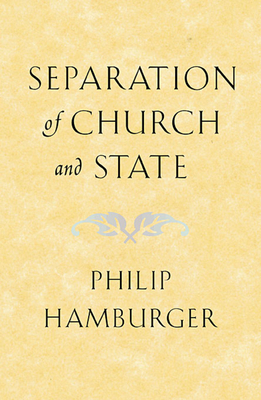
Separation of Church and State (Revised)
Description
In a powerful challenge to conventional wisdom, Philip Hamburger argues that the separation of church and state has no historical foundation in the First Amendment. The detailed evidence assembled here shows that eighteenth-century Americans almost never invoked this principle. Although Thomas Jefferson and others retrospectively claimed that the First Amendment separated church and state, separation became part of American constitutional law only much later.
Hamburger shows that separation became a constitutional freedom largely through fear and prejudice. Jefferson supported separation out of hostility to the Federalist clergy of New England. Nativist Protestants (ranging from nineteenth-century Know Nothings to twentieth-century members of the K.K.K.) adopted the principle of separation to restrict the role of Catholics in public life. Gradually, these Protestants were joined by theologically liberal, anti-Christian secularists, who hoped that separation would limit Christianity and all other distinct religions. Eventually, a wide range of men and women called for separation. Almost all of these Americans feared ecclesiastical authority, particularly that of the Catholic Church, and, in response to their fears, they increasingly perceived religious liberty to require a separation of church from state. American religious liberty was thus redefined and even transformed. In the process, the First Amendment was often used as an instrument of intolerance and discrimination.
Separation of Church and State (Revised) (ISBN-13: 9780674013742), written by Philip Hamburger, was published by Harvard University Press in 2004-03-30. The Separation of Church and State (Revised) textbook is widely used in colleges and universities across the country. You can rent or buy Separation of Church and State (Revised) from Valore, along with many other new and used textbooks. Valore provides affordable textbooks, trusted sellers, and fast delivery to help you succeed in your studies.
Frequently Asked Questions
The most affordable way to get Separation of Church and State (Revised) by Philip Hamburger is usually renting. We offer flexible rental periods, as well as options to buy it used or new at a discount. Check the pricing table above for the current lowest price.
Used books and rentals do not guarantee an active access code. If your professor requires a platform like Connect, MindTap, or MyLab for homework, you may need to purchase an access code separately.
We know the syllabus moves fast! Standard shipping usually takes 3-5 business days, but we offer expedited shipping options at checkout so you can get Separation of Church and State (Revised) before your first major assignment.
You can rent Separation of Church and State (Revised) (9780674013742) for a standard 125-day semester term or a 90-day quarter term, with options to extend your rental. You just need to return it by the due date listed on your order.
Yes! We have a textbook buyback program. If you purchase the physical copy of Separation of Church and State (Revised), you can enter your ISBN (9780674013742) into our sell back page at the end of the term to see the current offer, print a shipping label, and get paid. Just make sure to check out our sell back condition guide first so you know what we accept!
We understand schedule changes happen. You can return Separation of Church and State (Revised) for a refund within 14 days after the delivery of your item, provided it is in the same condition it was sent in. See our return policy for more information.
Yes! If your professor only requires the online homework platform (like Connect, MindTap, or MyLab), you can purchase a standalone access code for Separation of Church and State (Revised) without buying a physical book, provided we currently have the standalone code in stock.